 Nima Leclerc
Explained · 04 · Conference paper · CLEO 2025
Filming a magnetic field as it changes
Walsh Imaging: a way to recover a magnetic signal’s shape in time and space, without knowing it in advance.
The problem
Diamond quantum microscopes can take pictures of magnetic fields with nanotesla sensitivity, which is useful for studying cells, chips and circuits. But most of them rely on constant fields, or on signals that oscillate at one known frequency. A real signal, such as a firing neuron or a switching transistor, is neither. Its shape in time is arbitrary, and you often do not know it beforehand.
The idea: borrow from signal processing
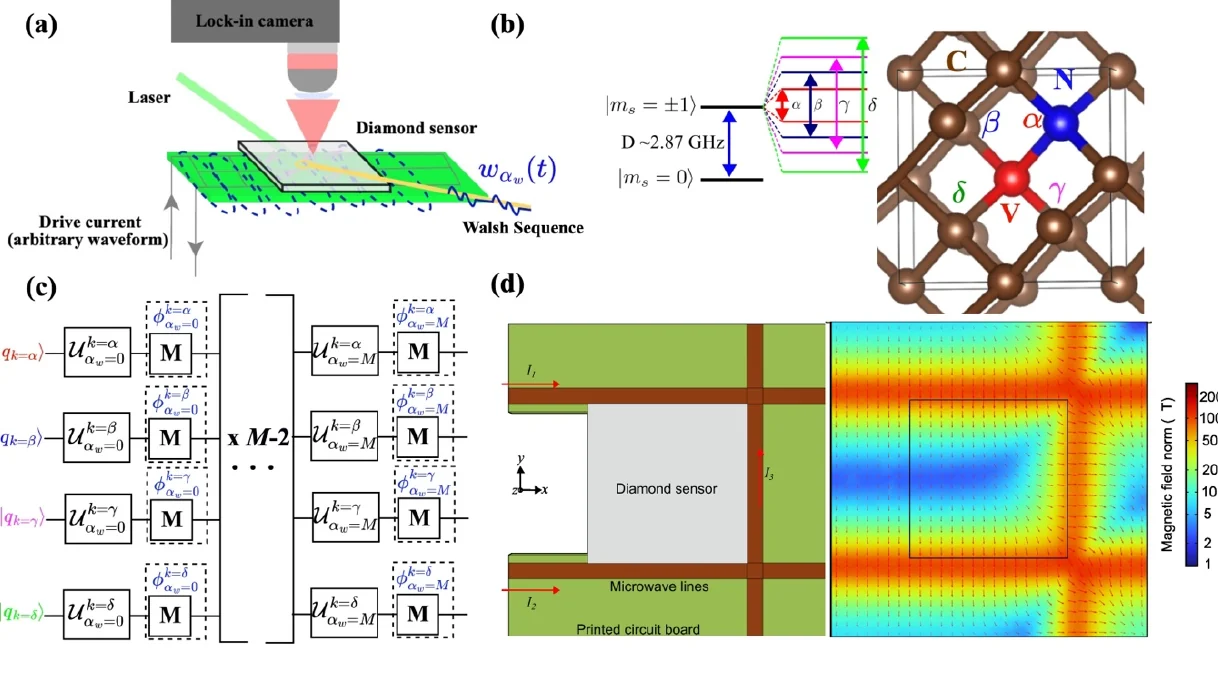
Think of how a piece of music can be written as a sum of pure tones. Walsh functions are a cousin of that idea built from square waves that flip between +1 and −1. Any signal can be described as a sum of them, and, helpfully, a quantum sensor can be made to “listen” for one Walsh function at a time simply by timing the flips (π-pulses) that we apply to its spins.
In Walsh Imaging, we apply a series of these Walsh-patterned pulse sequences to a diamond sensor and record each result with a lock-in camera, which gives a picture across the whole sensor at once. Each run measures one Walsh component of the signal at every pixel. Collect enough components and you can rebuild the full signal over time, and do it for all four NV directions to recover the field’s direction too.
More components, better picture
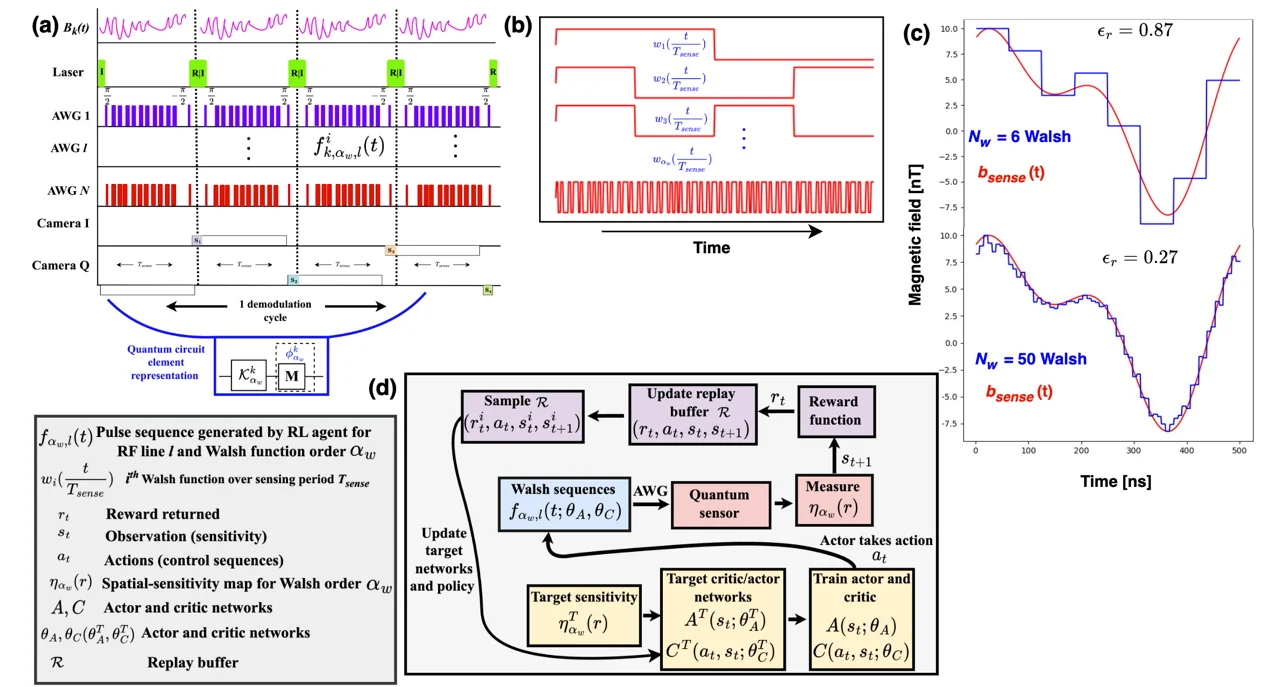
In simulation, reconstructing an arbitrary waveform with 6 Walsh components captures its rough shape (relative error 0.87), while 50 components follows it closely (relative error 0.27).
Letting an algorithm tune the sensor
Real sensors are imperfect. The microwave field varies across the diamond, and noise limits sensitivity. So we added reinforcement learning, the kind of algorithm that learns by trial and reward. Here an agent chooses the microwave pulse sequences on the independent control lines of the circuit board and is rewarded when the measured sensitivity map approaches a target, so it can adapt the sensor’s sensitivity in space and time while it runs.
The limits
This work reports the scheme and simulations. It is a concept paper: the benefit of the learning-based tuning and the full imaging protocol still has to be shown on a real device. The method was later covered by a patent application, described in a separate explainer.