 Nima Leclerc
Explained · 05 · Patent application · US 2026/0252935 A1
Spatial, temporal and vectorial quantum sensing
The patent application behind Walsh Imaging, explained without the legal language.
What problem does it address?
A quantum sensor measures something, here an electromagnetic field, by preparing quantum bits, letting the field nudge them, and reading out the result. The standard pulse sequences have a trade-off. A Ramsey sequence can see where a constant field is and which way it points, but not how it changes in time. Sequences such as Hahn-echo and dynamical decoupling can see time variation, but they work best when you already know the signal’s frequency and that it is a single tone.
The application notes that the standard sequences can recover some, but not all, of the properties of an unknown, arbitrary signal. That is the gap.
The core idea
Apply a family of orthonormal pulse sequences to the qubits, meaning sequences that do not overlap with each other in the mathematical sense, so each one picks out its own piece of the signal. Walsh functions are the example used. Capture images of the light the qubits emit after each sequence, and process them to reconstruct the signal’s spatial pattern, its temporal shape and its vector direction.
How the system is laid out
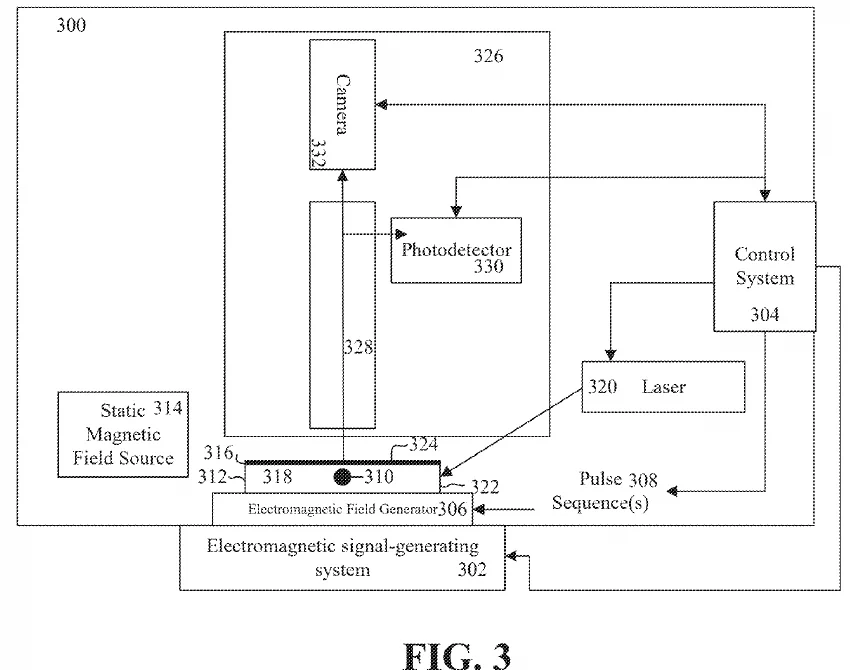
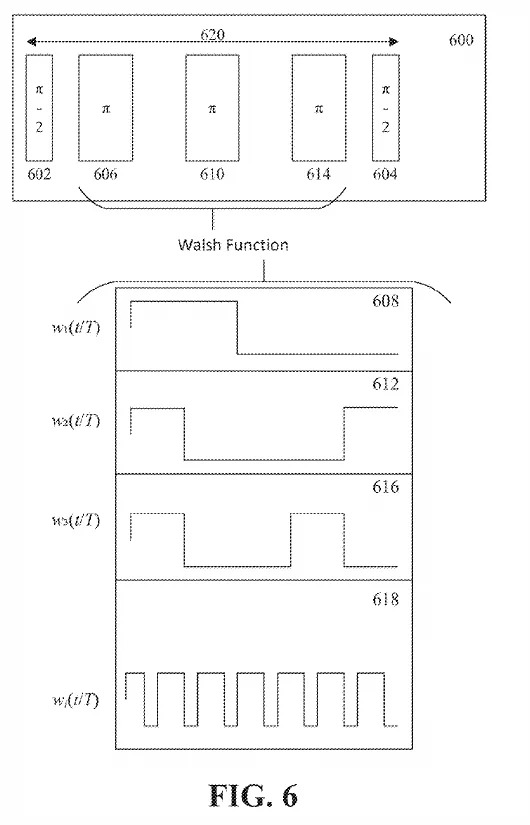
In the diagram, a control system coordinates a laser, an electromagnetic-signal generator that delivers the pulse sequences, and a camera that images the diamond. A static magnet sets the operating point. The right-hand figure shows the structure of a single sequence: two π/2 pulses bracket a series of π pulses whose timing follows a particular Walsh function.
The application also shows the same kind of simulated reconstruction as the Walsh Imaging paper: a coarse set of Walsh components gives a rough picture of an arbitrary waveform, and a larger set follows it closely.
What this document is, and is not
This is a published application, not a granted patent. It describes an invention; the claims may change during examination, and I am not the right source for legal interpretation. I include it here because it is the clearest statement of the idea, and because it shows where the research was headed: toward sensors that report the whole story of a field, not a single number.