 Nima Leclerc
Explained · 01 · Paper · Physical Review B
Steering a single spin with an electric field
How flipping the polarity of a crystal can turn the magnetic compass inside it, worked out atom by atom on a computer.
The problem
Most of today’s electronics move charge. A growing field called spintronics wants to move spin instead, the tiny magnetic compass needle carried by every electron, because flipping a spin can cost far less energy than pushing current through a wire. The catch is control: how do you point an individual spin where you want it, using only an electric voltage, without a bulky magnet?
One answer is to put the spin inside a ferroelectric, a crystal with a built-in electric polarization that can be reversed by an applied field. If the crystal’s internal electric environment is what tells the spin which way to point, then flipping the polarization should turn the spin along with it.
What we studied
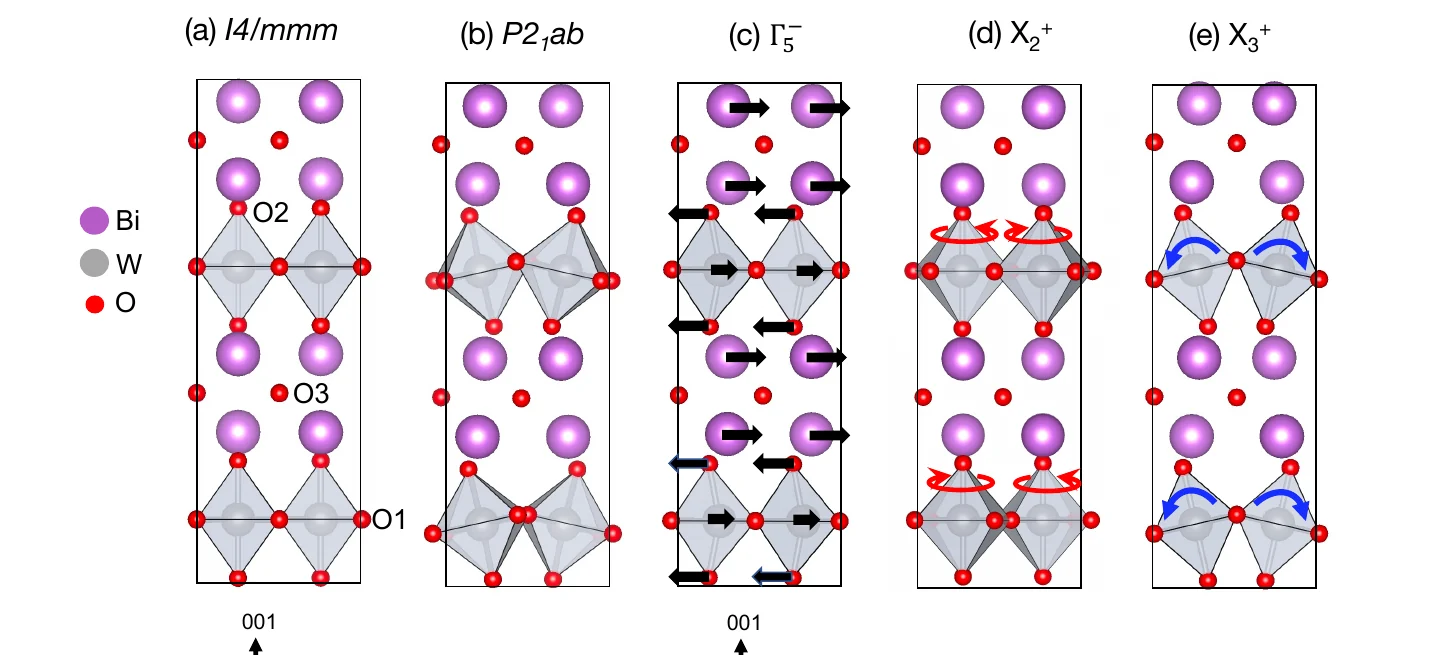
We looked at bismuth tungstate, Bi2WO6, the simplest member of a family of layered oxides called Aurivillius phases. Its structure is distorted from a high-symmetry parent in three ways at once: the bismuth atoms shift against oxygen (this makes the polarization), and the oxygen cages around tungsten rotate and tilt.
Two questions, answered with quantum-mechanical simulation
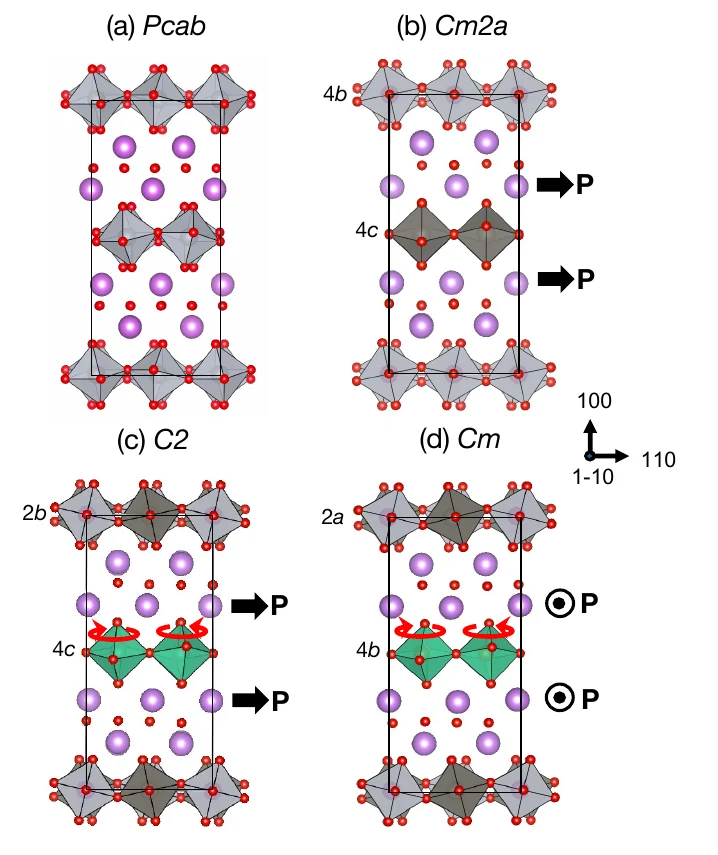
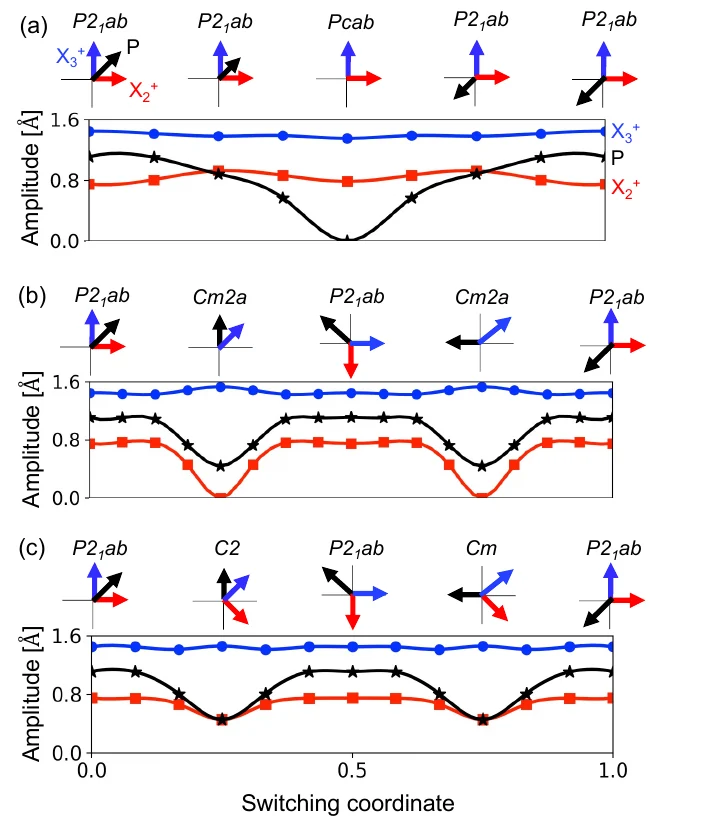
1. How does the polarization actually flip? Because each of the three distortions can point in several symmetry-related directions, there are many possible routes from “up” to “down”. We used group theory to list the in-between structures and density functional theory, a standard method that computes a material’s energy from the quantum mechanics of its electrons, to rank them. The cheapest route is not a single jump but two steps through intermediate structures, called C2 and Cm.
2. What does the spin do on the way? We swapped a few tungsten atoms for iron, which carries a spin, and computed the direction the spin prefers (its “easy axis”) at every stage of the switch. In the starting structure the easy axis sits close to the polarization direction. As the crystal passes through the two-step route, the preferred direction rotates with it.
The result
A 90° switch of the polarization produces a 112° reorientation of the spin’s easy axis. In other words, an electric field can steer a dilute magnetic dopant, and the amount it turns is not simply tied to the angle the polarization turns. The low symmetry of this crystal, and the coupling between the spin and the lattice around it, are what make that possible.
Why it matters, and the limits
This is a computational prediction, not a measurement, and it treats one kind of dopant in one host. What it offers is a recipe: a way to enumerate switching pathways and then read off how a spin responds. That is useful when searching for materials where a voltage could write the state of a single spin, an ingredient for low-power spintronics and for spin-based quantum devices.